The conversation about AI in enterprise environments has matured past the “should we?” phase. The harder question now is how – and in mission-critical environments like HPE Nonstop, how you answer that question matters enormously.
The systems running on HPE Nonstop didn’t get there by accident. They power payments, banking, retail, telecommunications, and fraud prevention because they’ve earned that position over decades of production use. The business logic encoded in these applications, the operational workflows, the transactional integrity – that’s institutional knowledge embedded in software. It doesn’t get rebuilt overnight, and it shouldn’t need to be.
So when AI vendors talk about “unlocking your data” it’s worth being precise about what that actually means in a Nonstop context. The value isn’t simply in the data these systems hold. It’s in what the systems do with that data – the rules, the workflows, the carefully constructed transaction flows that sit behind every Pathway server class. Exposing raw data to an AI platform without that context produces mediocre results at best, and introduces governance risk at worst.
The better framing is capability, not access.
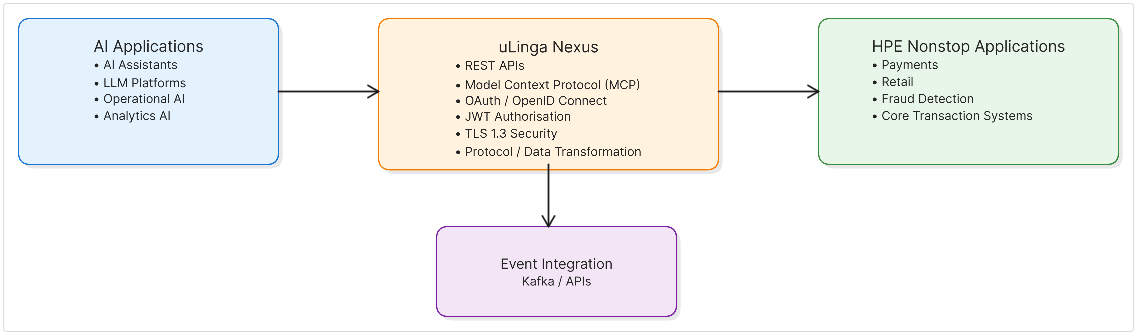
In our earlier articles – Bridging Worlds: AI Meets Nonstop Through Model Context Protocol and AI and the Nonstop Advantage – we examined why Nonstop environments are well positioned for AI integration and how MCP, implemented through uLinga Nexus, provides a standards-based bridge between AI systems and existing applications. What we haven’t yet addressed is what you actually build once that bridge exists.
What works in practice
In our experience, the most effective enterprise modernisation efforts and AI deployments augment existing systems rather than attempt to replace them. This is especially true in Nonstop environments, where the cost of getting it wrong is high and the tolerance for operational disruption is low.
Practical use cases tend to fall into a few categories: AI-assisted operational support, real-time fraud and anomaly detection, conversational interfaces over existing business workflows, and knowledge tools that help teams navigate complex legacy environments. None of these require replacing the underlying application. All of them benefit enormously from being able to interact with live operational state rather than stale exports.
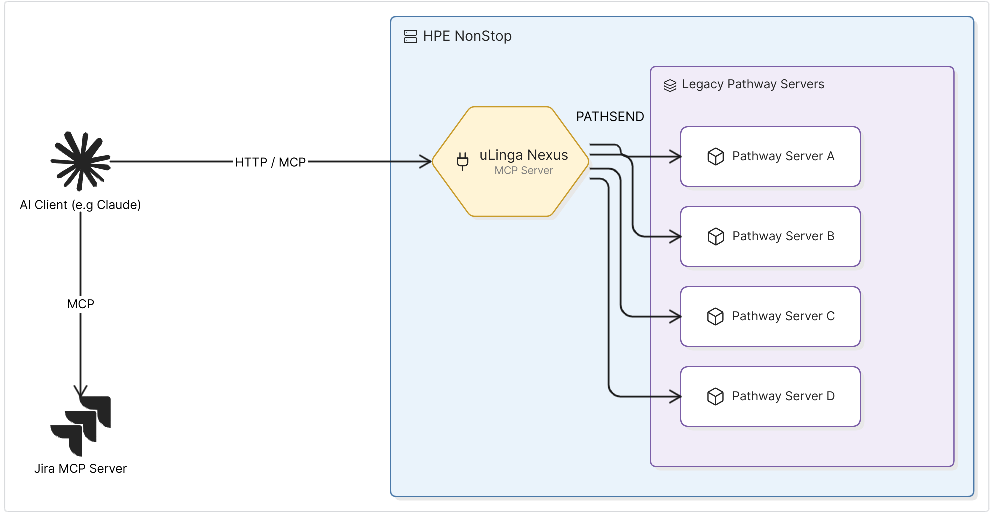
Consider what troubleshooting a traditional Pathway-based Nonstop application actually looks like. Support staff issue PATHCOM commands to check server status, inspect queue states, analyse process behaviour – then execute test transactions through SCOBOL requestor applications to isolate a problem. It’s a process that requires significant operational knowledge, and it’s predominantly manual.
Through MCP interfaces exposed by uLinga Nexus, an AI assistant can interact directly with those same capabilities. Individual Pathway server transactions become MCP tools. PATHCOM monitoring commands become queryable interfaces. The AI doesn’t replace the operational workflow – it orchestrates across it, correlating state from multiple servers, executing guided test transactions, and summarising findings in plain language for the engineer who then makes the call.
Paired with enterprise tooling like Jira, the picture becomes genuinely useful: the assistant retrieves the incident, interacts with the Nonstop environment through governed interfaces, runs diagnostics, and hands back actionable guidance – all within the controls the organisation already has in place.
The pattern plays out at scale in the payments industry. One of the world’s largest card networks runs an AI fraud detection system that scores every transaction in under 50 milliseconds, trained on more than 125 billion annual transactions. The result: fraud detection rates up by 300%, false positives down by half. The AI didn’t replace the transaction infrastructure – it was layered on top of decades-old authorisation systems that continue to run unchanged. The platform doing the heavy lifting on transaction processing is the same one it has always been. The AI sits alongside it, doing what the original system was never designed to do.
A second network tells a similar story. Its AI authorisation product builds on transaction scoring infrastructure that has been in continuous production for over 30 years – not a pilot, not a proof of concept. Today it processes upward of 76,000 transactions per second across more than 200 countries and is credited with preventing an estimated $28 billion in fraud annually. The AI layer is relatively recent; the transaction infrastructure underneath it is not. That’s the point – the same proven platform, doing more.
Governance isn’t optional
Moving from experimentation to production AI deployment surfaces requirements that aren’t always front-of-mind in the proof-of-concept phase. Authentication, auditability, and operational control matter in mission-critical environments in ways they simply don’t in a sandbox.
uLinga Nexus runs natively on HPE Nonstop and supports OAuth, OpenID Connect, JWT, and TLS – not as bolted-on extras, but as core integration capabilities. More importantly, it allows organisations to expose curated capabilities to AI systems rather than providing unrestricted backend access. That distinction – between a governed API surface and a fire hose – is what separates an AI deployment that a risk team will approve from one that never makes it to production.
This is also where the incremental approach pays off. Exposing one operational capability at a time, proving it out, then expanding is far more manageable than attempting a wholesale AI integration across a complex Nonstop application estate. The architecture supports it; the governance model demands it.
The point isn’t transformation – it’s extension
There’s a reality that rarely makes it into vendor white papers: getting significant changes implemented in large financial institutions takes years. Not quarters – years. A major bank evaluating a new core platform isn’t making that decision in a budget cycle. The procurement process alone can outlast multiple technology generations. The risk and compliance review, the integration testing, the staff retraining – by the time a replacement project completes, the world it was designed for has often moved on.
This isn’t a criticism. It’s the rational behaviour of organisations that cannot afford to be wrong. And it’s precisely why the AI-enabling argument is more credible than the AI-replacing one. If the goal is to deliver capability in the next two years rather than the next ten, working with existing infrastructure isn’t a compromise – it’s the only realistic path.
HPE Nonstop systems run some of the world’s most demanding transactional workloads. They do so because of properties – fault tolerance, linear scalability, continuous availability – that AI platforms don’t replicate and weren’t designed to. The opportunity isn’t to migrate away from those properties in pursuit of something newer. It’s to extend the value of systems that already work into operational and analytical workflows that previously required significant manual effort.
That’s a more modest claim than “AI will transform your business.” It’s also a more honest one – and in production environments where the stakes are high, honesty about what AI can and can’t do is the foundation of any deployment worth building.
This article is part of an ongoing series on practical AI integration within HPE Nonstop environments. Future pieces will examine secure AI governance frameworks, event-driven AI architectures, and operational AI assistants in greater depth. For more information about uLinga Nexus, contact Infrasoft at info@infrasoft.com.au.